How to Build Workforce Training Programs With Pell Grants

Why Workforce Training Programs Matter Now
For years, many of the short workforce training programs your institution runs sat outside federal financial aid. Traditional Pell Grants were designed for longer programs, so an eight-week EMT or welding course usually had to rely on state grants, employer funding, or out-of-pocket tuition.
That changed on July 1, 2026. Workforce Pell Grants now extend federal aid to short, job-focused programs, and the first approvals are already in. The U.S. Department of Education approved the nation's first Workforce Pell program, a 14-week EMT program at Iowa Central Community College, and Eastern Florida State College followed with four approved public safety programs.
If you lead workforce, continuing education, or academic programs at a college or university, this guide walks you through how to build workforce training programs that qualify for Pell funding and keep qualifying year after year.
What Workforce Pell Grants Cover
So, what is workforce training in this context? It's career-focused instruction that prepares people for a specific job or industry, often in a few weeks or months rather than years. The workforce pell grant program requirements set clear limits on which of these programs qualify. Under the final rule, an eligible program must:
- Run 150 to 599 clock hours over at least 8 but fewer than 15 weeks.
- Be offered by an accredited institution that is eligible for federal student aid.
- Have operated for at least one year before approval.
- Train for a high-skill, high-wage, or in-demand occupation approved by the governor.
- Lead to a stackable, portable credential that carries academic credit toward a longer certificate or degree.
- Meet outcome standards, including 70% completion within 150% of normal time and 70% employment in the second quarter after exit.
Approval happens in two stages: first by the governor's office, then by the Secretary of Education.
5 Steps to a Workforce-Ready Program
With the rules clear, here's a practical sequence for building a program that qualifies and keeps qualifying. Work through these five steps in order, starting with the one requirement you can't change: your state's approved occupation list.
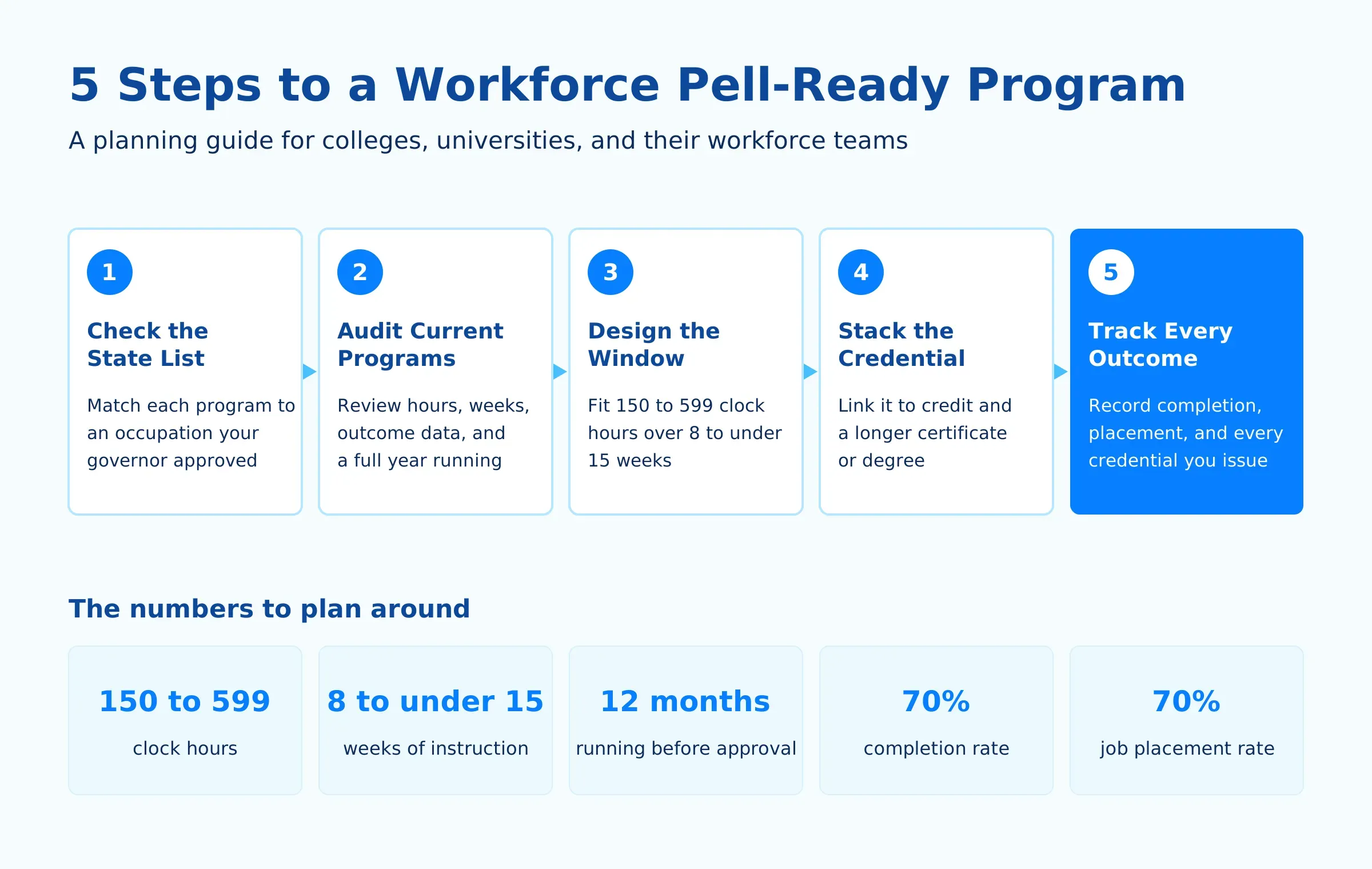
1. Start With Your State's List
Every program begins with your state's list of approved occupations, and those lists vary a lot. Community College Daily reported that Pennsylvania approved 19 occupations while North Carolina approved 364. By late September, UPCEA counted more than 30 jurisdictions with working approval pipelines.
A few practical moves:
- Find your authorizing body. It might be your higher education board, workforce department, or another agency.
- Map each program to one occupation. Document the link in writing so your application is easy to review.
- Talk to employers early. An industry advisory board can confirm the skills and credentials local employers actually hire for.
In a short-list state, your choices are made for you. In a wide-list state, choose programs you can defend on outcomes, not just the ones that are easy to launch.
2. Audit the Programs You Already Run
You likely have workforce development training programs that are close to eligible already. Modern Campus recommends auditing each one for:
- clock hours and weeks of instruction,
- completion and placement data from past cohorts,
- tuition and fees,
- the credential awarded and whether it carries academic credit.
Flag any program that has run for less than a year or has gaps in its outcome data. Those need work before they can apply.
It also helps to form a cross-functional team early. Workforce Pell touches academic affairs, continuing education, the registrar, financial aid, and institutional research, so everyone needs to be at the table.
3. Design for the Eligible Window
Many types of workforce development programs already fit the 150 to 599 hour range: EMT, certified nursing assistant, phlebotomy, commercial driving, welding, and HVAC are common examples. Others need adjusting.
- Too long? Split a longer certificate into an approved first stage and a follow-on stage that builds on it.
- Too short? Add hands-on labs, clinical hours, or an employer-based practicum.
- Mixed delivery? Keep the format consistent, since the year of operation is measured on the same hours and weeks.
If you run related instruction for a Registered Apprenticeship, check the apprenticeship flexibilities, which allow partners to deliver up to 49% of an eligible program.
4. Build Stackable, Portable Credentials
This is where many workforce certificate programs need the most work. Achieving the Dream notes that the stackable and portable requirement means breaking down silos between noncredit and credit divisions.
- Set up articulation agreements so completers earn credit toward a longer certificate or associate degree.
- Choose an industry-recognized credential that more than one employer values.
- Write clear badge criteria that list the skills assessed and where the credential leads next.
Digital credentials make this easier to show. We cover the full approach in our guide on how digital credentials support Workforce Pell programs, and our breakdown of competency vs completion badges can help your faculty pick the right badge for each stage.
5. Track Outcomes From Day One
Placement data usually comes from state unemployment insurance wage records, and New America points out that many noncredit programs sit outside state data systems entirely. Don't wait until you apply to start collecting.
- Record enrollment and completion dates for every cohort.
- Stay connected with completers after they finish.
- Keep a dated record of every credential issued.
A credential worth sharing helps here. When completers add a verified badge to their LinkedIn profile, your team gains a visible signal of where they landed. These eight ways to encourage credential sharing can help.
Plan Around Outcome Standards
The 70% completion and placement standards apply through the 2028-29 award year. After that, the rules tighten: placement must match the program's target occupation starting in 2029-30, and a value-added earnings test follows in 2030-31.
That earnings test caps tuition and fees at a program's value-added earnings, which Higher Ed Dive explains as graduates' median earnings minus 150% of the federal poverty line. A program that misses its targets can lose eligibility for at least two years.
To protect your results:
- Offer wraparound support like advising, tutoring, and flexible scheduling.
- Partner with employers on hiring pipelines, not just curriculum review.
- Price programs carefully against realistic local wages.
How Wauld Supports Your Programs
Once your workforce programs are approved, every completer needs a credential that is easy to issue, share, and verify. Wauld for training programs gives your teams one place to:
- Design branded credentials from 1,200+ certificate and badge templates.
- Issue to whole cohorts at once, with the option to edit or void records.
- Organize by department using separate workspaces and role-based access.
- Verify instantly through unique links aligned with Open Badges 3.0 and W3C Verifiable Credentials.
- Track engagement, including opens, shares, and LinkedIn additions.
Bringing It All Together
Workforce Pell Grants give colleges and universities a real chance to expand short workforce training programs with federal support. The institutions that do it well will start with their state's list, design programs inside the eligible window, build credentials that stack, and track outcomes from the very first cohort.
Start with one program that already has strong employer demand and solid data. Get it approved, learn from the process, and build from there.
Give every completer a credential worth sharing
Issue stackable, portable, verifiable certificates and badges for every workforce program you run, all from one platform built for institutions.
FAQs on Workforce Training Programs
Can private training providers get Workforce Pell Grants?
Only accredited institutions that are eligible for federal student aid can offer Workforce Pell programs. They can work with outside partners under a written agreement for a limited share of a program.
How long must a program run before it qualifies?
A program must have been offered for at least one year with the same clock hours and weeks of instruction before it can be approved.
What types of programs qualify for Workforce Pell?
Programs of 150 to 599 clock hours, lasting 8 to under 15 weeks, that train for an occupation on your state's approved list. Common examples include EMT, nursing assistant, phlebotomy, welding, and commercial driving.
What happens if a program misses the 70% targets?
A program that fails the completion or placement standards loses Workforce Pell eligibility for at least two years.
Can four-year universities offer Workforce Pell programs?
Yes, as long as the institution is accredited, eligible for federal student aid, and the program meets every requirement. So far, most approved programs are at community colleges, which gives universities room to step in with employer-aligned offerings.