EMT Certification: Improve Student Retention and Issue Certificates

Running an EMT certification course is demanding, but the hardest part is not teaching the material. It is getting students to finish and walk away with a credential that proves what they can do. This guide explains what an EMT actually is, how to keep more students enrolled through to the exam, and how to issue professional EMT certificates that employers trust.
What Is an EMT?
An EMT, or Emergency Medical Technician, is a certified professional who delivers frontline emergency medical care. EMTs assess patients, manage airways, control bleeding, and stabilize people for transport to hospital. They are the backbone of emergency medical services (EMS) and work alongside paramedics, firefighters, and other public safety teams.
EMT is one level on the EMS career ladder, which runs from Emergency Medical Responder (EMR) up through EMT, Advanced EMT, and Paramedic. Each step adds scope of practice, deeper training, and greater responsibility.
To earn the credential, students complete a state-approved EMT training program, typically 120 to 180 hours that blend classroom theory, hands-on skills labs, and supervised clinical or field time. They then pass the National Registry of Emergency Medical Technicians (NREMT) exam, which tests both cognitive knowledge and psychomotor skills. Because that hands-on component is mandatory, EMT certification is rarely fully online. The strongest programs deliver didactic content online and run skills and clinical work in person.
That hybrid structure is exactly where completion problems tend to begin, which brings us to retention.
How to Improve Student Retention
EMT programs lose students for reasons that have little to do with how hard the material is. They lose them to structure: unclear expectations, shaky foundations, an overwhelming pace, and progress that feels invisible. The patterns are consistent enough to map.
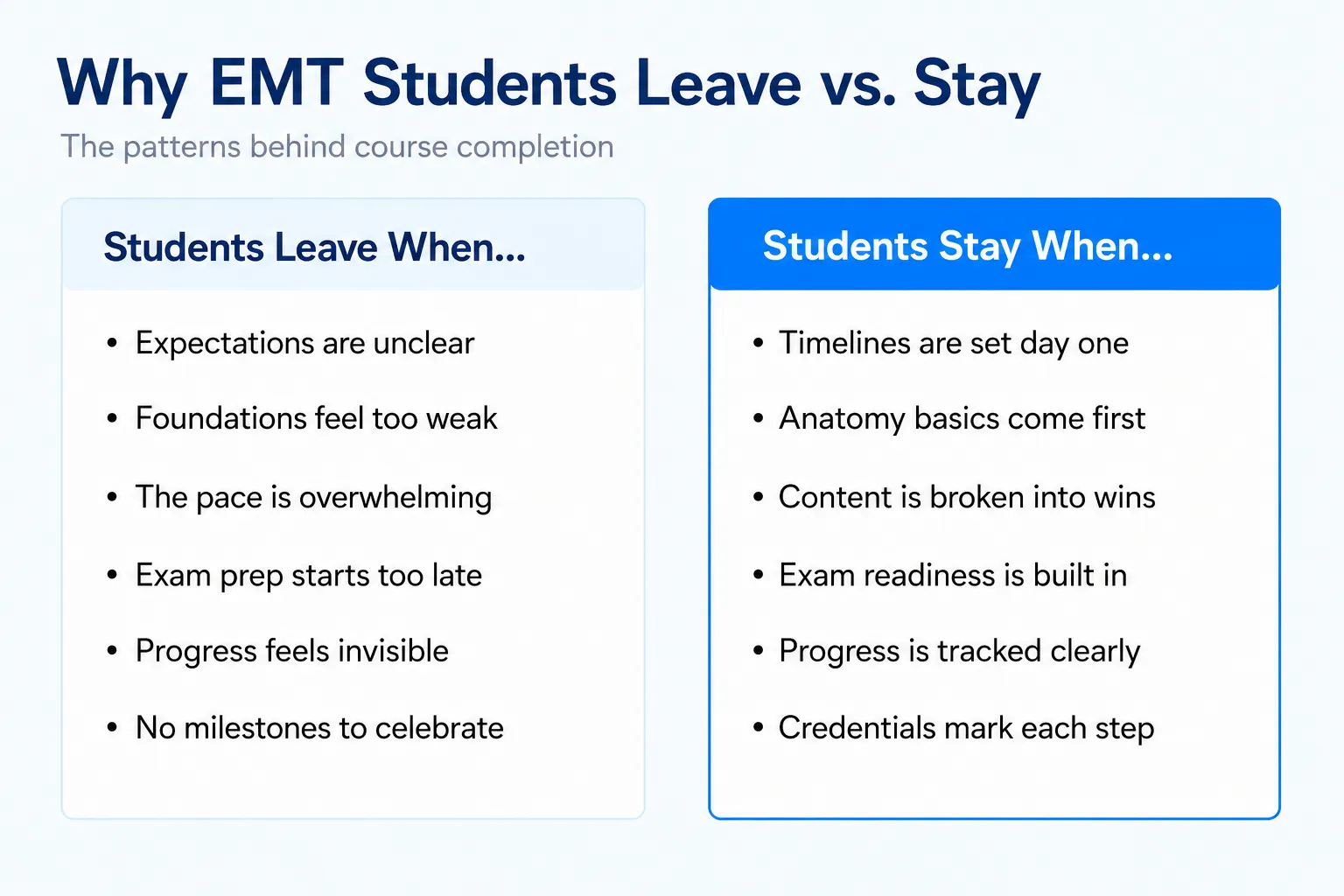
Every reason students leave is a fixable structural choice, and every reason they stay is something you can build in deliberately. These five steps do exactly that.
- 1
Set Clear Expectations on Day One
Most drop-offs are decided before the real content starts, so answer the questions every EMT student is silently asking:
- Total course hours and how many weeks the program runs
- The clinical and lab commitment, and the full cost
- The NREMT exam timeline and a realistic weekly study load
- 2
Build Strong Clinical Foundations First
EMT content is cumulative, so a weak base sinks every later module. Front-load the fundamentals:
- Anatomy, physiology, and medical terminology before anything else
- Core patient assessment skills before high-acuity scenarios
- Confidence checkpoints so no one advances on shaky ground
- 3
Pace Content Into Small Wins
A 150-hour course is intimidating as one block and manageable as fifty small ones. Break it down:
- Short, single-sitting lessons with a clear "done" marker
- Modular units, quick knowledge checks, and a visible progress bar
- Automatic progress tracking so learners always know where they stand
- 4
Prepare for the Exam Throughout
Exam prep that starts in the final two weeks is a classic reason students panic and quit. Make practice a habit instead:
- NREMT-style questions at the end of every module
- Realistic exam format and difficulty from week one
- Low-stakes, repeated practice that builds exam-day confidence
- 5
Reward Progress With Verifiable Credentials
Invisible progress is demotivating, so mark every milestone with a digital badge and issue a professional certificate at completion. A credential only carries weight if it holds the right data, so make sure each EMT certificate or badge includes:
- The recipient's full name and the exact credential earned
- The issuing training center or academy, with its logo and an authorized signature
- The issue date, plus any expiry or renewal date
- A unique credential ID and a QR code linking to a public verification page
- The hours completed or competencies covered, and any NREMT or state reference
For a sense of how these fields sit on a finished design, see Wauld's medical certificate templates.
Why EMT Certificates Matter
A certificate turns invisible learning into visible proof. For students, an EMT certificate is both motivation during the course and something concrete to show on a resume, a job application, or LinkedIn afterward. It marks a real milestone in a safety-critical profession.
For employers and field agencies, the certificate is a fast, trustworthy signal of competency. In emergency medical services, where a bad hire carries real risk, a verifiable EMT certificate confirms that a candidate met a recognized standard, without a round of phone calls to check. That verification also protects your program's reputation against forged or exaggerated credentials.
Certificates are not only for the finish line, either. Issuing digital badges for interim milestones keeps learners engaged and gives them shareable recognition along the way. As we cover in why course certificates are a must for your online course, the credential is often what turns a completed course into a career move. The same logic applies to adjacent training such as BLS certification.
Issuing Certificates With Wauld
Wauld sits alongside your course platform and turns any tracked completion, a single module or the full EMT program, into a branded, verifiable certificate or digital badge. Every credential carries a unique ID, a QR code, and a public verification page, so anyone can confirm it is genuine in seconds.
The workflow is built for training providers. Start from a professional certificate template, customize it with your logo, signature, and fields, then automate issuance so credentials go out the moment a learner meets a milestone. You can bulk-issue to an entire cohort, and recipients can download a print-ready PDF for their records. The free plan covers up to 300 credentials a year, automation included.
That combination, visible progress during the course and trusted proof at the end, is what makes credentialing a retention tool rather than an afterthought.
Final Thoughts
An EMT delivers emergency medical care under pressure, and the training that gets someone there is demanding by design. You cannot make the material easier, but you can build the course so more students finish it: set expectations early, secure the foundations, pace the work into wins, thread exam prep throughout, and reward every step with a credential learners can see and share. Do that, and completion stops being something you hope for and becomes something your EMT program reliably produces.
Turn every EMT milestone into a verifiable certificate
Create a free Wauld account and issue up to 300 branded, QR-verified certificates and badges a year.
FAQs on EMT Certification
What is an EMT? An EMT, or Emergency Medical Technician, is a certified professional who provides frontline emergency medical care such as airway management, bleeding control, and patient stabilization. EMTs work in emergency medical services alongside paramedics and other public safety teams.
Can you complete an EMT certification course fully online? Not entirely. The didactic portion can be delivered online, but the NREMT still requires demonstrated psychomotor skills and clinical or field experience, so accredited programs run as a hybrid of online coursework and in-person labs and rotations.
How long does an EMT certification course take? Most EMT-Basic programs run between roughly 120 and 180 hours, spread over a few weeks to several months depending on the schedule. Publishing the total hours and weekly study load on day one helps learners plan and reduces early drop-off.
What should an EMT certificate include? A professional EMT certificate should carry the recipient's name, the exact credential earned, the issuing organization with its logo and an authorized signature, the issue and any renewal date, a unique credential ID, and a QR code linking to a public verification page.
What makes an EMT certificate verifiable rather than just a PDF? A verifiable certificate includes a unique ID, a QR code, and a public verification page, so employers and field agencies can confirm it is genuine. A plain PDF offers none of that, which is why platforms like Wauld issue credentials with built-in authentication.